
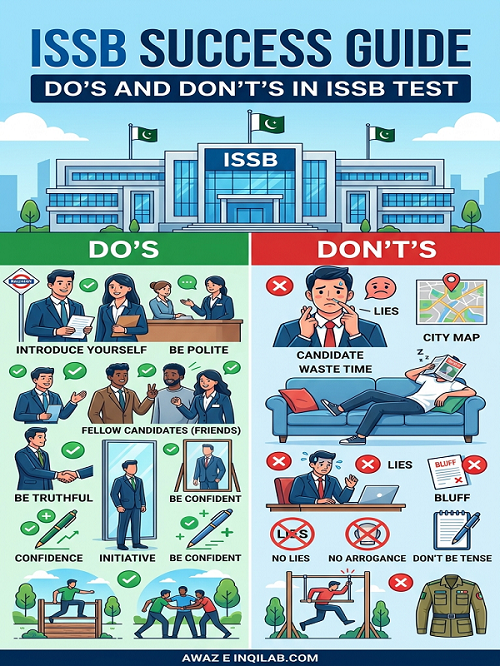
Book Name: DO’s and DON’T’s in ISSB Test
Author: Abdullah Yousafzai
Category: ISSB Test Preparation tips
Type: PDF Pages: 13
Mastering the ISSB Selection Process with Expert Guidance The Inter-Services Selection Board (ISSB) is the ultimate gateway for those aspiring to wear the uniform and serve their nation with honor. It is not merely a test of academic knowledge but a rigorous, multi-dimensional assessment of a candidate’s entire personality. Over several days, candidates are observed, analyzed, and evaluated on their “Officer-Like Qualities” (OLQs), including leadership, integrity, emotional stability, and social adaptability. Many brilliant candidates fail not because they lack potential, but because they lack the specific understanding of how to project their best selves in this high-pressure environment. This is where the manual “DO’s and DON’T’s in ISSB Test” by Abdullah Yousafzai becomes a vital asset. This 13-page comprehensive PDF serves as a professional roadmap, breaking down the complex psychological and field-based requirements into actionable advice. It provides the clarity needed to navigate the GTO tasks, psychological screenings, and the final interview with unwavering confidence. By studying this guide, you are not just preparing for a test; you are refining your character to meet the standards of the world’s finest military institutions.
The Fundamental Importance of Physics in Military and Strategic Studies While the ISSB focuses on personality, the subject of Physics remains a cornerstone of military science and technological superiority. Physics is the study of how the physical world functions, and in a military context, it is indispensable. From the ballistics of a long-range artillery shell to the aerodynamics of a supersonic jet, every aspect of modern warfare is governed by physical laws. For an aspiring officer, a strong understanding of physics is not just an academic requirement—it is a practical necessity. It governs the communications systems (electromagnetism) that link units on the battlefield, the optics used in night-vision technology, and the structural engineering required to build resilient fortifications. Physics teaches a student how to quantify force, predict motion, and manage energy, which are the same skills required to manage complex tactical situations. By mastering physics, an officer gains a deeper appreciation for the tools at their disposal, ensuring they can lead with technical competence and innovative thinking in an increasingly digitized and high-tech combat environment.
Life-Changing Benefits of Studying Physics for Future Officers and Students Engaging with the study of physics offers profound benefits that directly align with the qualities sought by selection boards like the ISSB. Firstly, physics cultivates a “problem-solving mindset.” When a student works through a complex physical equation, they are training their brain to break down a large problem into smaller, logical steps—a trait that is identical to the Group Planning Exercises in GTO tasks. Secondly, physics builds mathematical precision and spatial awareness, which are crucial for navigation, map reading, and tactical maneuvering. Beyond the technical skills, physics instills a habit of objective reasoning. In physics, there is no room for “bluffing” or vague answers; everything is based on evidence and verifiable laws. This mirrors the integrity and honesty required during the ISSB interview. Furthermore, students of physics develop a resilience to failure; the process of trial and error in scientific experiments builds the mental toughness needed to face the obstacles of the ISSB field tasks. Ultimately, a background in physics ensures that a student is not only intellectually sharp but also practically grounded, making them a versatile candidate for any leadership role in the armed forces.
Expanded Features and Topics of the ISSB Guide by Abdullah Yousafzai This PDF is a specialized instructional manual that expands on official procedures with research-based insights. Below is a detailed explanation of the features and topics included in this 13-page guide:
Mastering the First Impression and Reception Protocol The guide emphasizes that the assessment begins the moment you step into the center. It provides detailed instructions on how to introduce yourself to reception staff with politeness and a firm handshake. It explains why this “Check-In” phase is critical—not just for administration, but as the very first data point in your social adaptability score. By presenting your call letter and CNIC with discipline, you immediately signal your readiness for the officer lifestyle.
Social Integration and Batch Dynamics A unique feature of this book is the emphasis on “peer judgment.” It explains how to make friends at the reception center and why your batch mates’ perception of you matters. The guide provides practical dialogue examples to start conversations, ensuring you aren’t isolated. It teaches you to behave like a “perfect Gentleman” at all times, as GTOs often take note of how you interact with your group behind the scenes.
Integrity, Honesty, and the PIQ Accuracy The book offers a deep dive into the importance of honesty. It provides a list of data points you must record beforehand—such as parent details, education, and achievements—to ensure your Personal Information Questionnaire (PIQ) is 100% accurate. It warns that any mismatch in information across the five days can lead to rejection, as honesty is a non-negotiable trait for an officer.
Grooming, Body Language, and Professionalism A dedicated section focuses on the “Smart Appearance” of a candidate. It instructs on clean dressing, polished shoes, and the habit of checking the mirror before leaving the room. Beyond clothes, it covers professional communication, such as addressing the group as “Gentlemen” or using chest numbers during formal discussions. This section transforms a raw candidate into a polished professional.
GTO Tasks and Group Discussion Strategies The guide provides tactical advice for the GTO (Group Testing Officer) phase. It explains the “Initiative + Cooperation” balance—how to speak up early in discussions without dominating others. It highlights the importance of knowing your group members’ names and qualifications to lead effectively during Group Planning and Command Tasks. This section helps you demonstrate leadership without appearing arrogant.
Psychological Testing and Positive Storytelling The manual explains the hidden logic behind the Word Association Test (WAT), Sentence Completion Test (SCT), and Thematic Apperception Test (TAT). It teaches candidates how to project positive, action-oriented responses that reflect patriotism and courage. It serves as a guide to ensure your subconscious mind is aligned with the required Officer-Like Qualities.
Interview Etiquette and the Anti-Bluffing Protocol For the final interview, the guide provides clear rules: stay calm, maintain eye contact, and never guess or make up answers. It explains the psychology of the interviewer and why saying “I am sorry Sir, I don’t know” is a sign of strength rather than weakness. It includes rehearsal tips for favorite questions and common current affairs topics.
Who Should Download This Book This guide is a mandatory read for any candidate appearing for the ISSB for the Army, Navy, or Air Force. It is especially beneficial for first-time candidates (freshers) who are unfamiliar with the environment and need a mentor-like figure to explain the “unwritten rules” of selection. Re-candidates will also find it useful to identify the subtle mistakes that might have led to their previous non-recommendation. Additionally, teachers and mentors at ISSB coaching academies can use this as a structured syllabus to train their students. Parents of aspiring officers should also read this to understand the mental and physical rigors their children are preparing for, allowing them to provide better emotional and logistical support during the preparation phase.
Download DO’s and DON’T’s in ISSB Test PDF by Abdullah Yousafzai Your journey to the khaki or white uniform begins with the right preparation. Don’t leave your selection to chance. Armed with the detailed explanations and research-based tips in this guide, you will be able to face the board with the poise and confidence of a true leader. This 13-page document is concise, high-impact, and designed to be your constant companion during your preparation days.
Detail
DO’s and DON’T’s in ISSB Test (Detailed Explanations for Every Point + Extra Research-Based Tips)
This guide expands on the official ISSB DOs and DON’Ts (commonly shared in ISSB procedure documents) with clear, practical explanations. Each point is explained in detail so you understand why it matters, how it affects your selection, and how to apply it practically. The ISSB assesses your officer-like qualities (OLQs) — leadership, initiative, cooperation, honesty, confidence, and social adaptability — from the moment you arrive until you leave. These tips help you demonstrate those qualities naturally.
DO’s
1. On arrival introduce yourself to the reception staff and show your documents. Introduce yourself politely with a firm handshake and a smile: “Assalam-o-Alaikum Sir, I am [Your Name], chest number [if allotted], here for ISSB.” Immediately present your call letter, CNIC, and other required documents. Why it matters: Reception staff are part of the assessment team. This creates an excellent first impression of discipline and respect. It also speeds up your check-in so you can focus on settling in. Many candidates who skip this step appear arrogant or careless.
2. Make as many friends as possible at the reception center itself. Start conversations while waiting in line or in the waiting hall: “Hi, I’m Ahmed from Peshawar, which city are you from?” Exchange names and basic info. Why it matters: Your batch mates (group) will observe and judge you from Day 1. Good rapport helps in GTO tasks where teamwork is tested. Isolation or rudeness signals poor social adaptability — a major rejection reason.
3. Remember you are being judged by your own batch mates right from the word go. Behave like a perfect Gentleman. Be courteous, helpful, and positive in every interaction — no swearing, no loud arguments, no showing off. Why it matters: GTOs and psychologists note peer feedback. Gentlemanly behaviour (respect for others, humility, helpfulness) is a core OLQ. Bad behaviour spreads quickly and can ruin your group image.
4. Keep a record of all the Bio data, for you will need this to fill up your arrival info form. Before leaving home, prepare a small notebook or phone notes with: full name, parents’ details, education history, achievements, hobbies, family background, etc. Why it matters: The Personal Information Questionnaire (PIQ) and arrival form must be filled accurately and quickly. Any mismatch with later forms or interview creates doubt about your honesty.
5. Do not give any false statement. Be 100% truthful in PIQ, psych tests, GTO discussions, and interview. Why it matters: ISSB psychologists and interviewers are trained to catch lies through contradictions. One lie can lead to immediate rejection. Honesty builds trust and shows integrity — a non-negotiable officer quality.
6. Always dress up neatly and appear smart. Before you leave your rooms spend a minute in front of the mirror. A man / woman are judged by others, by what he wears and what he speaks. Wear clean, well-fitted clothes (white shirt, dark trousers, polished shoes). Comb hair, trim nails, maintain hygiene. Check your appearance every morning. Why it matters: First impressions are powerful. Smart dressing shows self-discipline and respect for the institution. Sloppy appearance suggests lack of self-respect and attention to detail.
7. At the railway station itself buy a city guide it will help you to know about the city and its places of importance, bus route, train timings etc. Buy a small local map or city guidebook at the station. Note important landmarks, ISSB centre location, and emergency contacts. Why it matters: It shows preparedness and practical intelligence. Though transport is usually arranged, this knowledge helps if you need to move independently and demonstrates responsibility.
8. Always address the group as Gentlemen, or friends. His/her chest number allotted by the board should be used. (During Discussion and test only.) Say “Gentlemen, I think…” or “Chest No. 45 has a good point…” instead of “Hey you” or using real names in formal tasks. Why it matters: It creates a respectful, professional atmosphere. GTOs notice how you address the group — it reflects your leadership style and maturity.
9. Know each idle of your group by name his qualification; this will help you during GTOs Task. Try and become popular with them. Learn everyone’s name, city, education, and hobbies within the first day. Use this info to include them in discussions. Why it matters: In Group Planning Exercise and Command Tasks, knowing your group helps you lead effectively. It shows genuine interest in people — a key leadership trait.
10. Take initiative, be co-operative. Listen to others. As the time is at premium during discussions, speak up. Be bold and express yourself clearly be brief and do not repeat what others have said. It is better to speak either first or second, so that you will have an opportunity to put forward your points. In group discussions, listen first, then speak clearly and logically. Support good ideas from others while adding your own. Aim to speak early but not dominate. Why it matters: This is the perfect balance of initiative + cooperation — the most important OLQs tested in GTO. Repeating points or staying silent shows poor communication or lack of confidence.
11. During Psychological tests, always write positive sentences/story it should bring out the officer like qualities (of which you have been taught). In Word Association Test (WAT), Sentence Completion Test (SCT), and Story Writing, use positive, action-oriented responses that show courage, responsibility, teamwork, and patriotism. Why it matters: Psychologists look for consistency with officer qualities. Negative or vague responses reveal poor personality traits.
12. During interview if you do not know any answer politely say “I am sorry Sir, I don’t Know.” Never guess or make up answers. A calm “I don’t know, Sir” is better than bluffing. Why it matters: Interviewers value honesty over false knowledge. Bluffing gets caught and destroys credibility.
13. Be calm, cool and attentive. Smile while you enter the interviewing room and also say thank you, at the time of departure. Your handshake should be firm. Enter with a smile, maintain eye contact, sit straight, and end with “Thank you, Sir” and a firm handshake. Why it matters: Body language shows confidence and emotional stability. A firm handshake and polite exit leave a lasting positive impression.
14. The interviewing officer is a qualified gentleman, never bluff, you will get caught and spoil your chances of success. Answer naturally without exaggeration. Why it matters: Interviewers are highly trained psychologists. Bluffing creates contradictions with your psych tests and PIQ.
15. Be confident, rehearse some favorite questions. Practice common questions (about yourself, family, why you want to join armed forces, current affairs) at home. Why it matters: Confidence comes from preparation. Rehearsal reduces nervousness and helps you express thoughts clearly.
DON’T’s
1. No lies/false hood please. Never lie in any form or discussion. Why it matters: ISSB cross-checks everything. Even a small lie can lead to rejection.
2. You have no bad points except to over work to get perfection in any task under taken. When asked about weaknesses, turn them into positive traits: “I sometimes work too hard to achieve perfection, but I am learning to balance it.” Why it matters: Saying “I have no weaknesses” shows lack of self-awareness. A minor, workable “flaw” demonstrates maturity.
3. Do not Waste your time unnecessarily read some magazines. Instead of idle chatting or phone use, read newspapers, current affairs magazines, or defence-related material. Why it matters: Free time at ISSB is limited. Using it productively shows discipline and keeps you informed for interviews and discussions.
4. Don’t be tense take it easy, always think before you answer. Stay relaxed, breathe deeply, and think before speaking. Why it matters: Tension affects performance in every test. Calm candidates appear more mature and in control.
Additional Tips from Latest Research & Expert Advice (2025-2026)
These are proven tips from recent ISSB experiences, recommended candidates, and preparation guides:
- Physical fitness is non-negotiable: Start running (1.6 km in 8 minutes), push-ups, sit-ups, and obstacle practice 3–6 months before ISSB. Poor GTO performance is a top rejection reason.
- Stay updated on current affairs: Read newspapers daily (especially defence, Pakistan, and international news). Know important pacts, treaties, and military history.
- Be authentic in every test: Psychologists easily spot “faked” personalities. Consistency across PIQ, psych tests, GTO, and interview is crucial.
- Practice intelligence tests: Solve verbal and non-verbal IQ questions daily — screening test failure ends your chance before Day 1.
- Follow instructions 100%: Missing even small rules (dress code, timing, group behaviour) shows lack of discipline.
- Maintain grooming and hygiene throughout: Daily shower, clean uniform, polished shoes — every single day.
- Avoid common mistakes: Do not argue with GTO, criticize the armed forces, or show arrogance. Never compare yourself with others.
- Build real leadership: In group tasks, help weaker members and give logical solutions instead of shouting orders.
Queries: ISSB Preparation Tips, ISSB Dos and Donts PDF, Abdullah Yousafzai ISSB Book, Join Pak Army, ISSB GTO Tasks, ISSB Psychological Tests, ISSB Interview Questions, Officer Like Qualities, ISSB Solved PDF, Pakistan Armed Forces Selection, ISSB Recommended Tips, ISSB Command Tasks, ISSB Group Discussion, PIQ Form Guidance, ISSB Word Association Test, ISSB Story Writing, Leadership Qualities ISSB, Pak Navy Selection, Pak Air Force ISSB, Military Selection Board Tips.