
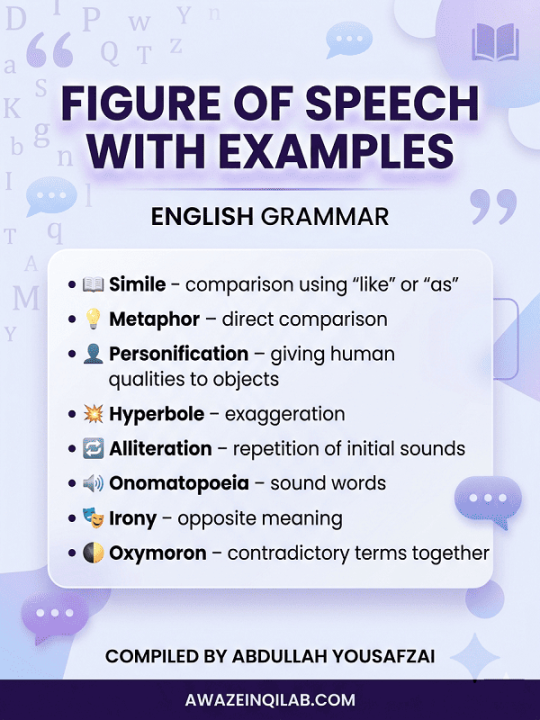
Book Name: Figure of speech with Examples
Category: English Grammar
Compiled by: Abdullah Yousafzai
Website: awaz e inqilab.com
The Power of Figurative Language in Mastering English Expression Language is not just a tool for literal communication; it is a canvas for creativity and emotional resonance. While the basic parts of speech provide the structure, “Figures of Speech” provide the color, depth, and artistry that make writing truly memorable. Whether you are reading a classic poem, a modern novel, or a persuasive speech, figures of speech are the primary elements used to evoke imagery and emphasize meaning. The “Figure of Speech with Examples” PDF, expertly compiled by Abdullah Yousafzai and hosted on awazeinqilab.com, is a specialized resource designed to help students and writers move beyond plain English. By mastering these literary devices, you gain the ability to express complex feelings and abstract ideas through relatable comparisons and stylistic flourishes. This guide is an essential companion for anyone looking to excel in literature exams or seeking to add a professional, creative edge to their personal writing style.
The Fundamental Importance of Physics in Scientific and Logical Inquiry While literary devices allow us to explore the nuances of human emotion, the subject of Physics allows us to explore the fundamental mechanics of the universe. Physics is the study of matter, motion, and energy, providing the scientific laws that govern everything from the microscopic vibration of atoms to the expansion of distant galaxies. Its importance in the modern world is all-encompassing; physics is the foundation of the technology that defines our lives, including the internet, medical lasers, and clean energy systems. For a student, physics serves as the ultimate trainer for logical reasoning. It teaches us how to observe the world objectively, identify patterns, and apply mathematical precision to solve problems. In an age of rapid technological change, the importance of physics is visible in every innovation, from the satellites that facilitate global positioning to the quantum processors of the future. By engaging with physics, students develop a deeper appreciation for the mathematical beauty of nature, ensuring they are prepared to lead in a world increasingly driven by scientific discovery and engineering marvels.
Life-Changing Benefits of Studying Physics for Students and Professionals Choosing to study physics, even for those primarily interested in the arts or humanities, offers a unique array of cognitive and professional benefits. Firstly, physics is the premier discipline for developing high-level analytical and critical thinking skills. It requires a student to take a complex, real-world scenario and reduce it to its fundamental components—a skill that is highly sought after in law, medicine, and executive management. Secondly, physics builds exceptional mathematical intuition. By applying math to physical reality, students learn the practical utility of numbers, making mathematics far more rewarding and less abstract. Another major benefit is the development of a “precision-first” mindset. In physics, accuracy is paramount; this instills a lifelong habit of detail-oriented work and rigorous double-checking. Professionally, a background in physics is the prerequisite for the world’s most innovative roles in aerospace, robotics, renewable energy, and telecommunications. Ultimately, studying physics empowers individuals to understand the mechanisms of the universe, providing them with the intellectual resilience to solve the great challenges of the 21st century with confidence and clarity.
Key Features and Detailed Topics of the Figures of Speech PDF This guide compiled by Abdullah Yousafzai is a meticulously organized resource that breaks down the most important literary devices. Below are the core types of figures of speech explained with detailed explanations:
The Art of Comparison: Simile and Metaphor
- Simile: This is a figure of speech that compares two different things using the words “like” or “as.” It is used to make a description more vivid and relatable. For example, “He is as brave as a lion.”
- Metaphor: Unlike a simile, a metaphor makes a direct comparison without using “like” or “as.” It states that one thing is another to highlight a shared quality. For example, “The snow is a white blanket.”
Humanizing the Inanimate: Personification
- Personification: This device gives human qualities, emotions, or intentions to non-human objects, animals, or abstract ideas. It helps the reader connect emotionally with the setting or subject. For example, “The lightning danced across the sky.”
Emphasis through Extremes: Hyperbole and Understatement
- Hyperbole: This is an intentional and extreme exaggeration used for emphasis or effect. It is not meant to be taken literally but to convey strong feelings. For example, “I have a million things to do today.”
- Understatement: The opposite of hyperbole, this device deliberately represents something as much less significant than it actually is, often for ironic or humorous effect. For example, describing a massive flood as “a bit of a splash.”
Repetition and Sound: Alliteration and Onomatopoeia
- Alliteration: This is the repetition of the same initial consonant sound in a series of words. It creates a musical or rhythmic effect in writing. For example, “Peter Piper picked a peck of pickled peppers.”
- Onomatopoeia: This refers to words that phonetically imitate or resemble the sound they describe. It brings a sensory quality to the text. For example, “The bee buzzed” or “The door creaked.”
Contradiction and Irony: Oxymoron and Paradox
- Oxymoron: This brings together two contradictory terms to create a new, often deeper meaning. For example, “Deafening silence” or “Bittersweet.”
- Paradox: A statement that seems self-contradictory or absurd but may actually reveal a hidden truth. It forces the reader to think more deeply about the subject. For example, “The only constant is change.”
Who Should Download This Book This “Figure of Speech with Examples” PDF is an essential resource for a wide variety of learners. It is a must-have for middle and high school students who are studying English literature and need to identify these devices in poems and stories. Competitive exam aspirants (such as those preparing for GRE, SAT, or CSS) will find it helpful for the verbal reasoning and precis writing sections. Teachers can use this document as a handout for their classes or as a quick-reference guide for creating lesson plans on creative writing. Additionally, bloggers, poets, and aspiring authors will find this to be a perfect “creative toolkit” to help elevate their prose and make their writing more engaging. Even for general readers, understanding these figures of speech adds a new layer of enjoyment to reading, as it allows them to appreciate the stylistic choices made by their favorite authors.
Download Figure of Speech with Examples PDF compiled by Abdullah Yousafzai Are you ready to transform your writing from ordinary to extraordinary? Clarity is important, but creativity is what makes your voice stand out. By downloading this expert-curated guide from awazeinqilab.com, you are taking a major step toward academic excellence and literary mastery. Don’t let your writing feel flat or uninspired. Empower your expression, master the art of the metaphor, and join the thousands of students who trust our platform for the highest quality educational materials.
Queries: Figure of Speech PDF, Literary Devices with Examples, Abdullah Yousafzai English Notes, Awaz e Inqilab Grammar, Learn Simile and Metaphor, Personification Examples, Alliteration and Hyperbole, English Literature Guide, Download Grammar PDF, Creative Writing Tools, Figurative Language PDF, English for Students, Poetry Analysis Guide, Grammar Reference PDF, Master Figures of Speech, English Exam Prep, High School English Notes, Literary Terms PDF, Examples of Oxymoron, Onomatopoeia List.