
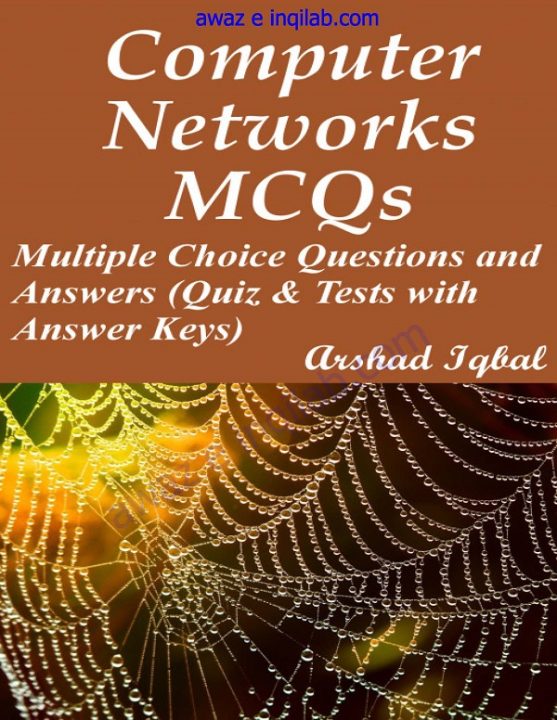
Computer Networks MCQs and Answers( Quiz & testa with answer keys)
Introduction: Computer Networks MCQs Book
Computer Networks is one of the most important and core subjects in Computer Science, Information Technology, Software Engineering, and Networking fields. Almost every modern system today depends on computer networks, including the internet, cloud computing, mobile communication, cybersecurity systems, and enterprise networks. To master this subject, theoretical knowledge alone is not enough; students must practice MCQs to test and strengthen their understanding. The book “Computer Networks MCQs” by Arshad Iqbal is a complete and comprehensive resource consisting of 577 pages, covering all major computer networking topics through carefully designed multiple-choice questions. This post provides full details about the importance of computer networks, benefits of studying this MCQs book, topic coverage, exam relevance, and a direct downloadable PDF link.
Importance of Computer Networks as a Subject
Foundation of Modern Digital Communication
Computer Networks form the backbone of modern digital communication. From sending emails to streaming videos and accessing cloud services, every activity relies on network principles. Understanding networking concepts is essential for building, maintaining, and securing these systems.
Essential for Computer Science and IT Students
Computer Networks is a compulsory subject in BSCS, BSIT, Software Engineering, DIT, ADP-CS, and other IT programs. Students must understand data transmission, protocols, routing, switching, and network security to progress in their academic and professional careers.
Core Requirement for IT Jobs
Most IT-related job roles require strong networking knowledge, including Network Administrator, Network Engineer, System Administrator, Cybersecurity Analyst, IT Support Engineer, Cloud Engineer, and DevOps Engineer. MCQs based on networking are commonly asked in recruitment tests and interviews.
Vital for Competitive Exams
Computer Networks MCQs are heavily used in competitive exams such as NTS, GAT, PPSC, FPSC, CSS (IT portion), PMS, BPSC, and other testing services. Practicing MCQs improves accuracy and time management.
Supports Advanced Technologies
Subjects like cloud computing, Internet of Things (IoT), artificial intelligence, and cybersecurity are built upon networking fundamentals. Without understanding computer networks, advanced technologies are difficult to learn.
Benefits of Studying Computer Networks MCQs
Concept Clarity Through Practice
MCQs help students revise theoretical concepts and identify weak areas. This book allows repeated practice of core networking topics to strengthen understanding.
Complete Exam Preparation
With 577 pages of MCQs, this book prepares students thoroughly for:
University exams
Competitive tests
Entry tests
Job interviews
Certification exams
Saves Time and Improves Accuracy
Instead of reading lengthy textbooks repeatedly, students can quickly revise important concepts using MCQs and answer keys provided in the book.
Improves Problem-Solving Skills
Networking MCQs test logical thinking, data flow understanding, protocol behavior, and network design concepts, helping students develop analytical skills.
Ideal for Self-Study
Students preparing at home without coaching centers can rely on this MCQs book to practice independently and evaluate their preparation level.
Covers All Difficulty Levels
The book includes basic, intermediate, and advanced-level MCQs, making it suitable for beginners as well as advanced learners.
Book Overview and Details
Book Name: Computer Networks MCQs
Author: Arshad Iqbal
Category: Computer Science
Type: PDF
Total Pages: 577
This book is structured chapter-wise, making it easy to study topic by topic while following standard computer networking syllabi worldwide.
Detailed Topics Covered in Computer Networks MCQs PDF
Chapter 1: Analog Transmission MCQs
Questions related to analog signals, modulation techniques, bandwidth, noise, and signal strength are covered in detail.
Chapter 2: Bandwidth Utilization – Multiplexing and Spreading MCQs
Includes MCQs on FDM, TDM, WDM, CDMA, and bandwidth efficiency.
Chapter 3: Computer Networking MCQs
Covers basic networking concepts, network components, types of networks, and communication models.
Chapter 4: Congestion Control and Quality of Service MCQs
Focuses on traffic congestion, QoS parameters, traffic shaping, and congestion avoidance techniques.
Chapter 5: Connecting LANs, Backbone Networks and Virtual LANs MCQs
MCQs related to bridges, switches, VLANs, backbone architectures, and internetworking.
Chapter 6: Cryptography MCQs
Includes encryption techniques, keys, algorithms, authentication, and confidentiality principles.
Chapter 7: Data and Signals MCQs
Covers digital and analog data, periodic and non-periodic signals, signal characteristics, and encoding.
Chapter 8: Data Communications MCQs
Includes transmission modes, communication models, and performance measurements.
Chapter 9: Data Link Control MCQs
MCQs on error control, flow control, framing, protocols, and ARQ mechanisms.
Chapter 10: Data Transmission – Telephone and Cable Networks MCQs
Covers PSTN, cable television networks, DSL, and broadband services.
Chapter 11: Digital Transmission MCQs
Includes line coding, block coding, scrambling, and digital transmission techniques.
Chapter 12: Domain Name System MCQs
MCQs related to DNS structure, name resolution, resource records, and hierarchy.
Chapter 13: Error Detection and Correction MCQs
Covers parity checks, CRC, Hamming codes, and error-handling mechanisms.
Chapter 14: Multimedia MCQs
Includes audio, video, image compression, streaming protocols, and multimedia networking.
Chapter 15: Multiple Access MCQs
Covers random access protocols, controlled access, channelization, ALOHA, CSMA, and CDMA.
Chapter 16: Network Layer – Address Mapping, Error Reporting and Multicasting MCQs
Includes ARP, RARP, ICMP, IGMP, and multicast concepts.
Chapter 17: Network Layer – Delivery, Forwarding and Routing MCQs
MCQs on routing algorithms, forwarding techniques, and network delivery methods.
Chapter 18: Network Layer – Internet Protocol MCQs
Covers IPv4, IPv6, packet format, fragmentation, and addressing.
Chapter 19: Network Layer – Logical Addressing MCQs
Includes subnetting, CIDR, IP classes, and address allocation.
Chapter 20: Network Management – SNMP MCQs
MCQs on network monitoring, management systems, MIB, and SNMP operations.
Chapter 21: Network Models MCQs
Covers OSI model, TCP/IP model, layers, and protocol responsibilities.
Chapter 22: Network Security MCQs
Includes authentication, access control, threats, and security mechanisms.
Chapter 23: Process to Process Delivery – UDP, TCP and SCTP MCQs
MCQs on transport layer protocols, port addressing, flow control, and congestion control.
Chapter 24: Remote Logging, Electronic Mail and File Transfer MCQs
Includes SMTP, FTP, TELNET, and application-layer services.
Chapter 25: Security in Internet – IPSec, SSL/TLS, PGP, VPN and Firewalls MCQs
Covers secure communication protocols, VPNs, encryption, and firewall concepts.
Chapter 26: SONET MCQs
MCQs on optical networking standards and synchronous optical networks.
Chapter 27: Switching MCQs
Covers circuit switching, packet switching, message switching, and ATM.
Chapter 28: Transmission Media MCQs
Includes guided and unguided media, fibers, cables, radio waves, and satellite communication.
Chapter 29: Virtual Circuit Networks – Frame Relay and ATM MCQs
MCQs on virtual circuits, Frame Relay architecture, and ATM networks.
Chapter 30: Wired LANs – Ethernet MCQs
Covers Ethernet standards, frame format, CSMA/CD, and LAN evolution.
Chapter 31: Wireless LANs MCQs
Includes Wi-Fi standards, mobile networking, and wireless access methods.
Chapter 32: Wireless WANs – Cellular and Satellite Networks MCQs
Covers cellular architecture, GSM, CDMA, LTE, and satellite communication.
Chapter 33: WWW and HTTP MCQs
Includes HTTP methods, web architecture, URLs, cookies, and web services.
Answer Keys
Complete answer keys are provided for self-evaluation and concept verification.
Why This Book is Highly Recommended
Complete Coverage
No other MCQs book offers such extensive chapter-wise coverage of computer networks.
Ideal for All Levels
Suitable for undergraduate students, postgraduate students, and competitive exam aspirants.
Exam-Oriented Approach
Questions are designed based on real exam patterns, making it highly reliable.
Trusted Author
Arshad Iqbal is well known for producing quality MCQs-based academic resources.
Conclusion
Computer Networks is a mandatory and high-scoring subject for computer science students and IT professionals. The Computer Networks MCQs PDF by Arshad Iqbal is a powerful resource for mastering networking concepts through practice. With 577 pages of carefully designed MCQs covering every major topic, this book is perfect for exams, interviews, and competitive test preparation. Download the PDF today and strengthen your command over computer networking.